Tuesday, 21 February 2012

KEJUT DARI MIMPI BENDA


Susulan blog sebelum ini tentang puSAKA kolotnial dan 'post-colonial future shock', izinkan saya meneruskan pelalutan. Walaupun drama puSAKA kolotnial ni sudah pun pernah saya langgan dulu semasa menuntut di Amerika Syarikat (1989-1993), takpalah, saya kongsi di sini. Dulu takda internet.

Sebelum itu dimaklumkan bahawa semua kata kunci 'kita' di sini merujuk juga kepada orang yang menulis blog ini.

Kita dengar dulu pesan Mahatma Gandhi berkaitan dengan pusSAKA kolotnial,

"Jika pemerintahan British digantikan esok dengan pemerintahan India berdasarkan kaedah-kaedah moden, India takkan menjadi lebih baik, kecuali ia hanya dapat mengekalkan sedikit wang yang telah pun disalurkan ke England; namun India hanya akan menjadi negara Eropah atau Amerika yang kedua atau kelima."

Maknanya lebih kurang begini, jika kita mengikut acuan yang ditinggalkan dari puSAKA kolotnial secara khinzir buta, kita hanya akan menjadikan salinan fotostat yang kabur.

Cuba tinjau pesan Claude Alvares dalam bukunya "The Blinded Eye:500 Years of Christopher Columbus". Bunyinya begini:

"...Columbus dalam diri kita sendiri mungkin merupakan penghalang yang lebih hebat dari Columbus di luar sana. Sainsnya, ekonominya, sikapnya terhadap alam, persepsinya terhadap gender dan kesihatan, pandangannya terhadap orang lain dan bahasa orang lain, telah meresap dan berakar dalam diri kita."

Pengalaman kolotnial telah menjajah dan bersarang merentas banyak generasi keturunan menerusi minda dan rasa kita. Penjajahan minda dan rasa adalah penjajahan yang telah memenjara kemanusiaan. Ia menghalang manusia (tak kira bangsa apa pun) dari kembali kepada fitrahnya. Pengalaman kolotnial adalah salah satu puSAKAnya. puSAKA ini boleh menyaka sesiapa dan apa jua, tak kiralah tinggi mana songkok, atau tebal mana pun serban. Tak kira apa jua jenama parti.

Bolehkah kita membebaskan diri dari puSAKA ini? Adakah semangat nasionalisma buta dan kebencian melampau terhadap pewaris penjajah dan warisan segala yang sekentut dengan Eropah dan  Amerika Syarikat itu boleh dijadikan penyelamat?

Pengalaman kolotnial telah menanam toksid yang membuatkan kita lupa bahawa sudah terdapat banyak ketamadunan yang jauh lebih hebat sebelum kedatangan penjajah. Sejarah ketamadunan dan keilmuan di China, India, Parsi, Mesir dan lain-lain daerah di Afrika ketika abad-abad pertengahan (disebut zaman gelap oleh dakyah kolonial) dipadam atau dicuri. Ia dipakej-semula menjadi jenama Eropah. Ilmu algebra, matematik, astronomi, falsafah, sosiologi, perundangan, logik, kejuruteraan, seni bina dll bentuk seni, dan banyak lagi, semua kena curi atau diberi jenama baru. Kalau tak pun, dijadikan 'dan lain-lain'.

PuSAKA kolotnial menanam toksid yang membuatkan kita memuja apa saja yang datang dari negara-negara 'membangun'. Kekayaan dan penguasaan (lebih tepat kerakusan) ekonomi dan teknologinya yang merebak kepada penguasaan politik, sosial, budaya, seni dll, telah membuat kita buta. Kita menjadi hamba kepada hegemoni intelek Eropah dan Amerika Syarikat. Kita mejadi mutan atau cyborg tidak bernama.

Kita juga menjadi peniru yang setia, termasuklah dalam hal pendidikan, seni dan budaya. Khazanah pengetahuan dan tradisi yang diwarisi tergadai, diganti oleh 'pengetahuan sedunia' yang sebenarnya berpaksikan Eropah dan Amerika Syarikat. Peta tauhid diganti dengan dengan peta Mercator.  Liberalisma kelas pertengahan, budaya konsumeris (sekarang ada 'retail therapy' tau!), kehidupan suburbia dan perluasan ruang peribadi (bukan ruang perkongsian) menjadi anutan yang jarang disoal.

Model pembangunan Eropah dijadikan kitab, walaupun ia terbukti membawa pada kepunahan alam (dan manusia). Penilaian tentang apa yang betul dan salah, baik dan jahat, cantik dan buruk, dan macam-macam lagi, semua ikut kanun bekas 'lord-lord' kolonial dari Eropah dan kini, juga dari Amerika Syarikat. Mesti ikut kanta mereka jika nak maju.

Sistem pendidikan kita pun ada yang nak ikut kanun 'lord-lord'. Dikepung oleh barisan kerusi dan meja macam kilang.


Kita sudah lama diceraikan dari warisan batin. Kita dah jadi 'yang lain-lain', terpinggir dan dipinggirkan. Kalau tak pun, kita jadi manusia dan menghasilkan mutan yang pelik.


Banyak sejarah dan khazanah ilmu dibunuh senyap-senyap oleh epistimologi saintifik Eropah. Warisan batin kita tak boleh dicerap dan dibukti secara empirikal mahupun saintifik. Jika tak boleh dicerap dengan pancaindera dan diuji secara 'benda' maknanya ia takda, tak wujud, hanya khayalan, tahyul. Inilah diktum puSAKA ilmu yang diwarisi dari pengalaman kolotnial. Ramai 'Columbus' jelmaan baru yang masih pakai diktum ini. 

Kini, yang kita ada adalah tinggalan jasad yang dah jadi bangkai (yang ramai pula nak pulihara atau awet buat tontonan dan nak sedapkan hati).

Bahasa kita yang menjadi saluran warisan batin (bukan bahasa tutur je ya, tapi juga bahasa tampak, bahasa bunyi dlll) pun makin pudar. Warisan batin kita (dan kemanusiaan) makin haus dicuri hari.


Kalau ditentang lebih-lebih, dituduh jumud, tertutup, kolot, primitif, tak saintifik, fanatik agama,dan sentrik-bangsa. Gema tuduhan sebegini masih kuat hingga kini. Penyalaknya ramai. 

Bagaimana pula pengalaman merenangi gelombang globalisasi hari ini? 

Tak payahlah sibuk sangat tanya soalan ini pada ahli-ahli politik. Mereka pun sibuk dan mungkin lebih hebat dalam menghentam dan mengutuk musuhnya dari menjawab soalan kita.

Malah, betul ke masih ada ahli politik dalam ertikata yang sebenar? Mungkin yang ramai sekarang adalah ahli perniagaan (yang berlakon sebagai ahli politik). 

Mana tidaknya, konsep negara-bangsa dan kerajaan (apa jua negara dan apa jua jenama kerajaan, kepartian dan 'pemain politiknya') kini boleh dimakan dengan mudah oleh raksasa bernama ekonomi pasaran bebas (dan kebas). 

Politik kini boleh dijadikan kuda tunggangan dan jenama pemasaran oleh bank-bank dan syarikat-syarikat mega trans-nasional (bukan syarikat bas ok) yang berkiblatkan tamak dan haloba melepasi segalanya. Untuk nampak mesra-manusia, syarikat-syarikat ini akan berlindung di sebalik topeng yang lebih mesra-lokal dan mesra-pelanggan....NGO-NGO atau pusat-pusat dan badan-badan pertubuhan 'sedunia'. Nak jadi sedunia atau 'world-class' kenalah ikut telunjuk mereka.


Adakalanya mereka dipanggil 'pakar' dan 'perunding' yang kerja dan nasihatnya (tentang segala aspek, termasuk seni dan budaya) mestilah dituruti. Mereka yang bagi piawaian. Sampai bila kita nak ikut piawaian mereka?
Mungkin agaknya sudah tiba masanya kita menghantar Columbus yang bersarang dan berkampung dalam minda dan rasa kita pulang. Perubahan mestilah bermula dari dalam diri kita sendiri, sebelum sibuk nak berdrama di luar.

Tiba masanya kita dibangunkan dari mimpi benda yang diwarisi dari puSAKA kolotnial. Mari kita berdoa, mohon petunjuk banyak-banyak, buka gelombang baru dan susul dengan amali yang istiqamah.  


Monday, 20 February 2012

POST-COLONIAL "FUTURE SHOCK"

What will the future of Malaysia and Malaysians be like?
Na, don't ask our politicians. Most of them are perhaps just good at bashing each other, even in answering our questions. Ask our visual artists instead.
"Future Shock" is a showcase of selected works from Universiti Sains Malaysia(USM) Fine Art Collection, under the acquisition of the Muzium & Galeri Tuanku Fauziah (MGTF). The show is currently being held at the Penang State Art Gallery. 
I am glowing with pride as I stroll into the exhibition space. Its a refreshing site to see artworks other than oil color and watercolor landscape, town-scape and still life. The show is curated by Afzanizam, a young curator from MGTF USM, with the assistance of the MGTF USM and Penang State Art Gallery teams. Afzanizam and these teams have been a part of my artistic fraternity in Penang. I am proud of them, despite some limitations that they have to face.
Ya I know, its not good to brag, and ya, USM Fine Art Collection is not meant as a bragging point. It is meant for research, study and deeper reflections or insights. It reflects the mental and emotional landscapes of Malaysia as a country or Malaysians as people. 
Anyhow I couldn't help but to glow with pride, because I was involved in collecting or acquiring the works, most of which were purchased from a very 'ciput' (small) yearly budget. Some other were donated by generous individuals. I am blessed, so thankful and full with gratitude.
I has been an honor to be given the privilege to further rejuvenate and develop the USM Fine Art Collection into an important collection for Malaysia and Malaysians to enjoy. USM may not be a rich institutional collector, it is just a government university. I had to compete with other departments and learn how to frame the collection as a very important form of knowledge repository (or knowledge capital, in the language of some clever people). I can't behave like some rich collectors that may collect at will. There are collection guidelines and policies to abide to (written by the previous committee, including Piyadasa and T.K. Sabapathy). 
I know some of the private collectors personally. Some are smart collectors who know what they are looking for. In fact, other than books, my feeders cum teachers when it comes to collection have been art collectors. Gallery owners, other directors and curators (including from outside Malaysia), academician friends and fellow artists have also been my teachers, advisers and critics too.
Despite budget constraint, I for one am very proud of the USM Fine Art Collection. These works are precious gems. They are partly the love of my life. I treasure them. I would love to invite all Malaysians to do the same. After all USM is a public institution. The collection is ours.
The displayed works in this show reflect the responds of Malaysian contemporary artists towards the imperatives of the future. The works predominantly imply a gloomy, dark and apocalyptic future, perhaps functioning as warning signs for us to ponder. 
Ya, I know, contemporary art exhibition (especially its opening reception) today may just be another excuse to socialize, network or simply 'be seen' (with who's who). And yes, I admit that after such glamorous opening, a contemporary art exhibition will mostly just be a means for economic transaction or exchange of expensive commodities. Catalogs may end up functioning as a branding channel meant to create a craving or needs (to own expensive commodity). Essays in catalogs may end up functioning more as a form of validation, other than to create an impression (or desired perception amongst potential buyers, few elite class or collectors). Artists may be seen as merchants of dreams. If one wants to claim that contemporary art has been reduced into such operational logic to fit into the matrix of globalization and free market capitalism, so be it.
But I prefer to chose my own take on contemporary art exhibition (and collecting contemporary art). It can be more than what has been explicated above.
My journey of acquiring artworks for the USM Fine Art Collection for the past seven years have been a journey of passion, love, joy and gratitude. But that will be a material for another blog entry.
For this entry, I just want to casually share some insights behind the selected works on display for the show. So here we go...
 

Al-khuzairi Ali's "In progress", 2009, terracota, steel, conrete, wood, and electrical component, overlooking the show. What kind of progress are we embracing? What kind of humans are we turning into? Al-Khuzairi's work is used as the 'persona' and index of the show.


View of "Future Shock" currently on at the Penang State Art Gallery. Congrats to Afzanizam (curator), MGTF team and Haryany and her team from the Penang State Gallery...a shinning example of a young team that can work together, despite the fact that both represent both federal and state institutions (of different government). Art cuts across political demarcation. Government comes and goes. Today, even a government (or some parts of it) can be taken over by the interests of large trans-national companies or entities hidden under so many pretexts. Malaysian people will determine their future. Despite whatever differences, we have to know how to work together on critical issues pertinent to the fate of our future.

TC Liew, "The more we get together", 2008, marker, acrylic, aerosol paint on redy made wooden chair, metal case. (lower right corner) . TC is a USM graduate, a conceptual storyteller who excels in playing with visual metaphors and semiotics of everyday objects. Am very pleased to have several of his works in the USM Fine Art Collection. Love his works. TC seems to ask, "Are we getting together or moving and drifted apart as we progress towards the future?"


TC Liew's work at the forefront with recently donated work by Hirzaq, by Nazli Aziz of the Chandan Gallery, KL. Was supposed to purchase Hirzaq's work, but could not do so due to budget cut. Very blessed for Nazli's generosity. Hirzaq's work calls me, it has a strong vibe. 

Is Malaysia an Asian tiger, or a dragon, or a leaping frog?

Figuring out TC's interactive puzzles.


Khairul Azmir Soib, "Kau mau kau tahu", 2008 (bottom). Enter the alternate world of Khairul (better known as Meme), very much reflective of the mind and emotional landscape of our post 2000 generation.


Reading Meme. So hard to predict the future as we try to get into the mind of our young generation.


Meme is a master of metaphorical narrative.


Trapped by Hui Koons's mouse traps.


Tan Hui Koon's "Pure fat crazy corn party", 2006. A rare piece not many prominent collectors would dare to purchase. Perhaps a parody of our corn shape KLCC. A fat party, a cage or a trap for the ever busy racing rats? 

Koon is currently a curator at the NVAG. Another USM's 'flower' that I am very blessed to witness.

One lucky 'gardener' of a small and relatively poor (in budget) university gallery reflected through one of his favorite 'catches' in the USM Fine Art Collection, Yee I-Lan's "Horizon series - Fencing, edition 7/8, 2003. 

KLCC, a symbol of success, a fence, or a fence that eats up the sustenance (pagar makan padi?). Horizon is a vision, but where actually our vision of the future is taking (or fencing) us?

A visual dialogue between two cyborgs, narrating an apocalyptic promise of our technological progress. What kind of future are we heading to? What is our take on technology and industrial progress? How do we balance it with our environment, culture, tradition and heritage? What kind of future generation that we would aspire to have? Cyborgs?

Bottom right, Shafiq Ali'am, "Tentacles", 2009, stainless steel, electronic laser, direct power motor, industrial mechanical parts and resin. With Abdul Latif Padzali's "Drown, accessories series", 2009, ready made object, bandage wire mash, plaster of paris on mannequin. A gloomy side of industrial progress, mechanically induced growth and technological 'achievements'.

With Abdul Latif Padzali's work. A work with a strong visual statement. It seems like our younger generation is warning us about our impending apocalyptic future if we don't change (our 'way of thinking and living') Living is about 'being' not 'consuming'.

Holding on to the machine, or are we becoming a machine, cold but efficient, with occasional breakdowns. 

Artificial intelligence with artificial head and limbs. We have artificial foods now. What's next? Artificial relationship and love?


With a very 'ciput' budget, I am nevertheless blessed to experience the privilege of developing a hopefully critical collection that reflects how Malaysian contemporary artists respond to present and future imperatives.

With Samsudin Abdul Wahab's "Pahlawan matahari bersepatu merah", lino cut, 2007. Look east but wear and walk west. Is this our direction towards the future? Buden's works are known for their clashing semiotics. This is my favorite choice of his lino cut series. 

I got one precious portrait done by Buden, also a lino cut work. As a poor person, it is my most precious treasure.

Always a pleasure to enjoy a collection that one has had the privilege to develop. These belong to USM, but the true owners are the people of Malaysia who appreciate local talents.


Syafiq Ali'am's "Flying machine after Leonardo", 2009, metal, stainless steel, motion sensor, hose tube, mechanical parts and resin. An animal cyborg of genetic engineering gone wrong.


Umibaizurah's work. Forgot the title, year 2009. I call this genie's child, a semi human hybrid from a monster called free market capitalism.


Need to put your back into your small bottle.

Umibaizurah's piece foregrounding Maizul Effendy's "Unus mundus (One world), 2007. One world under the homogenizing flag of google-lisation, free market capitalism and technological domination will lead us into what?.

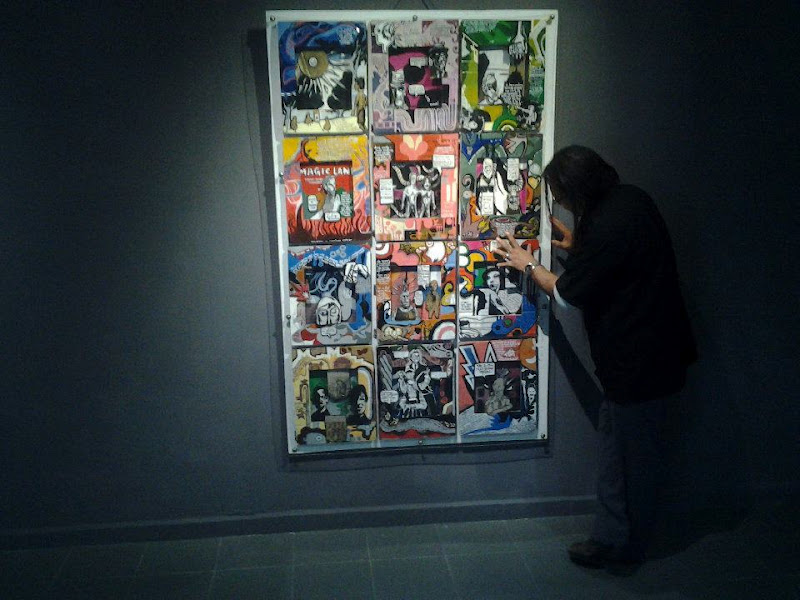
Reading Maizul's conundrum. Graphic novels are currently a popular form of artistic expression amongst the younger generation. Some of which are embedded and laden with socio-political connotations.


With Haslin Ismail's "The door", 2008. So many doors to chose, so many stairs to climb as we face our crossing junctures towards the future.


Another Zulkifli Dahalan revisited, this time from the work of Saiful, a talented designer/artist from USM. Reflection of a state of humanity gone awry.

Paiman's weird character from his alternate dimension. Our visual artists seem to be rather well connected to the other dimension. Paiman donated this piece. Thank u 'brader'. USM also has Paiman's rare preparatory drawings and sketches for his installation works. Can't afford to purchase his large installation, but drawings are more intimate. This is Zulkifli Dahalan revisited, a parody of the absurdity that has become the common picture of our political landscape and the echoing media (both offline and online).

Cutting through Mohd Sarip's work, very talented and skillful artist. Are we cultivating values from fictional popular characters to transform our future generation? Transforming into what?


Flexing muscles with Ruzzeki' Harris's "Invulnerable", mixed media on metal sheet, 2009. Male chauvinism, apollonian masculinity. linear logic and Darwinian survival of the fittest (or rather richest) still prevail.


Fooling and pulling around with Fadly Sabran's "The anthropoid genetic", 2009, steel, rubber, aluminum, metal, electronic board, flash light, mini tv, video and sound. Fadly is another electronic wizard of contemporary Malaysian art. 

Is robotic technology turning us into a machine or are we trying to turn robots into humans? Recalling "Blade Runner".


Haris Abadi' "Read the wingdings", 2009. Single channel video projection on 3D setting. A seminal work that should be placed as a critical pioneer of video mapping application in the local and regional contemporary art scene. Haris 's works are precious gems. Perhaps, the lack of boldness and appreciation of creative and groundbreaking work within the collectors fraternity is a blessing in disguise. I hope I'm wrong though. It has allowed me to purchase Haris's works for USM without too much competition.


Back to school. What is the future of our educational system, from primary school to university? National school, vernacular school, international school, private school, religious school, so many schools? English or Bahasa Melayu or Bahasa Kebangsan, or Arabic, or Chinese or Tamil? By the time they enter the universities, even their lecturers are confused.

What kind of dragon are we going to become, or are we still the Asian tigers.


K Azril, "Morning", 2009, another rare catch. Documenting the majestic legacy (but sad demise) of Keretapi Tanah Melayu's workshop due to redevelopment of Brickfield. There is always a price to pay in our race towards the future. What is Brickfield now? What will be the next victim? Jalan Sultan in KL?


A dream that finally comes true. Ismail Zain's seminal digital collage series in the USM Collection finally. Ismail Zain was like a visionary guru who read the oncoming future and provided us with warning signs. Feeling high, blessed and full of gratitude to be with the works of my sifu. Al-Fatihah for Ismail Zain who had opens so many hidden doors and veils for me.

There are several video art works shown in this show, by Ahmad Fuad Osman, Masnoor Ramli, Nadiah Bamadhaj, Tengku Azhari, Sharon Chin, Vincent Leong, Roopesh Sitharan, Nur Hanim Khairuddin, Fuad Ariff, Ikram Al-Hafiz and Colemann Abdullah. USM also owns editions of video works by Wong Hoy Cheong and Hayati Mokhtar, but their works would require other contexts to be exhibited.

USM owns a large numbers of seminal video art pieces by Malaysian contemporary artists, a fact to is hard not to brag about. Bragging aside, the collected video works are very pertinent in regards to some of the diverging conceptual, technical and thematic trajectories in the local contemporary art practice.

These are just some casual in-sights. Can't beat seeing the works in their exhibition space though. 

For related blog, click on:

http://hasnulsaidon.blogspot.com/2011/12/post-2000-transformation-or-is-it.html 

On USM video art collection:
http://issuu.com/mgtfusm/docs/malaysia_s_6_jahanam_vs_japan_s_7_samurai

DEKAT DI JANTUNG YU XIN

DEKAT DI JANTUNG YU XIN Apa yang tersurat di wajah mungkin tak sama denga apa yang dibaca oleh ECG. Ini yang diterokai oleh Yang Yu Xin. Dia...